
Does your Garland yard need a French drain?
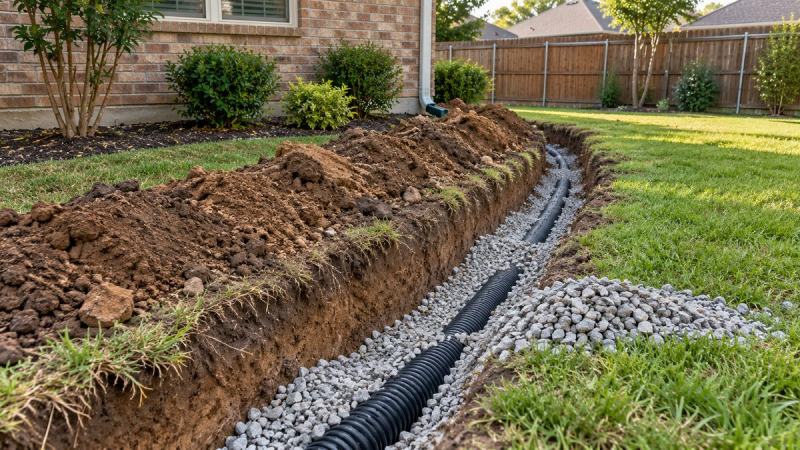
If water stands in the same spot for more than a day or two after rain, or pools against your foundation, you likely need better drainage. Try extending downspouts, cleaning gutters and regrading first. If water still stands, a French drain is the standard fix.
Garland sits on blackland clay. Dry, it cracks wide enough to lose a phone in. Wet, it holds water like a bowl, and some yards stay soggy for days. In the back corner of the lot, that's annoying. Against the foundation, it's a problem.
Signs of a real drainage problem
- Standing water for more than a day or two after rain, in the same spot every time.
- A soggy strip along the foundation, or water pooling at a corner of the house.
- Mushy, yellowing grass in one low area while the rest of the lawn is fine.
- Water coming under the fence from the neighbor's higher lot.
- Mosquitoes in one part of the yard all summer.
- Slab cracks, doors that stick after rain, or damp spots in the garage. Clay that swells and shrinks against a foundation is what moves it, so keeping water away is foundation maintenance.
Try these first, they cost less
- Extend the downspouts. One downspout dumping at a corner puts hundreds of gallons against the foundation in a single storm. Carrying it six to ten feet out fixes a surprising number of "drainage problems."
- Clean the gutters. Full gutters overflow at the corners, which is the same as having no gutters.
- Regrade. Ground should slope away from the house. Years of mulch and settling often leave it flat or sloping in.
- Check the sprinklers. A broken head or a zone that runs too long keeps one spot wet all summer.
What a French drain actually is
A sloped trench with perforated pipe at the bottom, wrapped in filter fabric and surrounded by gravel. Water soaks into the gravel, enters the pipe, and flows to somewhere it can go: the curb, a dry well, a swale or a lower part of the lot. Then it's covered with sod, mulch or rock and you forget it's there.
What makes one work or fail:
- Slope: at least an inch of fall per ten feet. Flat pipe holds water instead of moving it.
- An outlet lower than where the water starts. Without one you've built an underground bathtub.
- Filter fabric, or clay silts into the gravel and clogs it in a couple of years.
- The right location, usually across the slope above the wet area, not right where the puddle sits.
Common Garland layouts
- Along the foundation, a few feet out on the side that stays wet.
- Across the back yard, catching water that runs from the back fence toward the patio.
- Along the fence line, when the neighbor's yard drains into yours.
- Under a new sod install, so the new lawn doesn't get torn up later.
A typical residential French drain is a day or two of work. We can tie the downspouts into the same line, and when we're done the only visible sign is a grate or pop-up emitter at the outlet.
Get it looked at
Free drainage estimates in Garland, Rowlett, Sachse, Richardson and East Dallas.